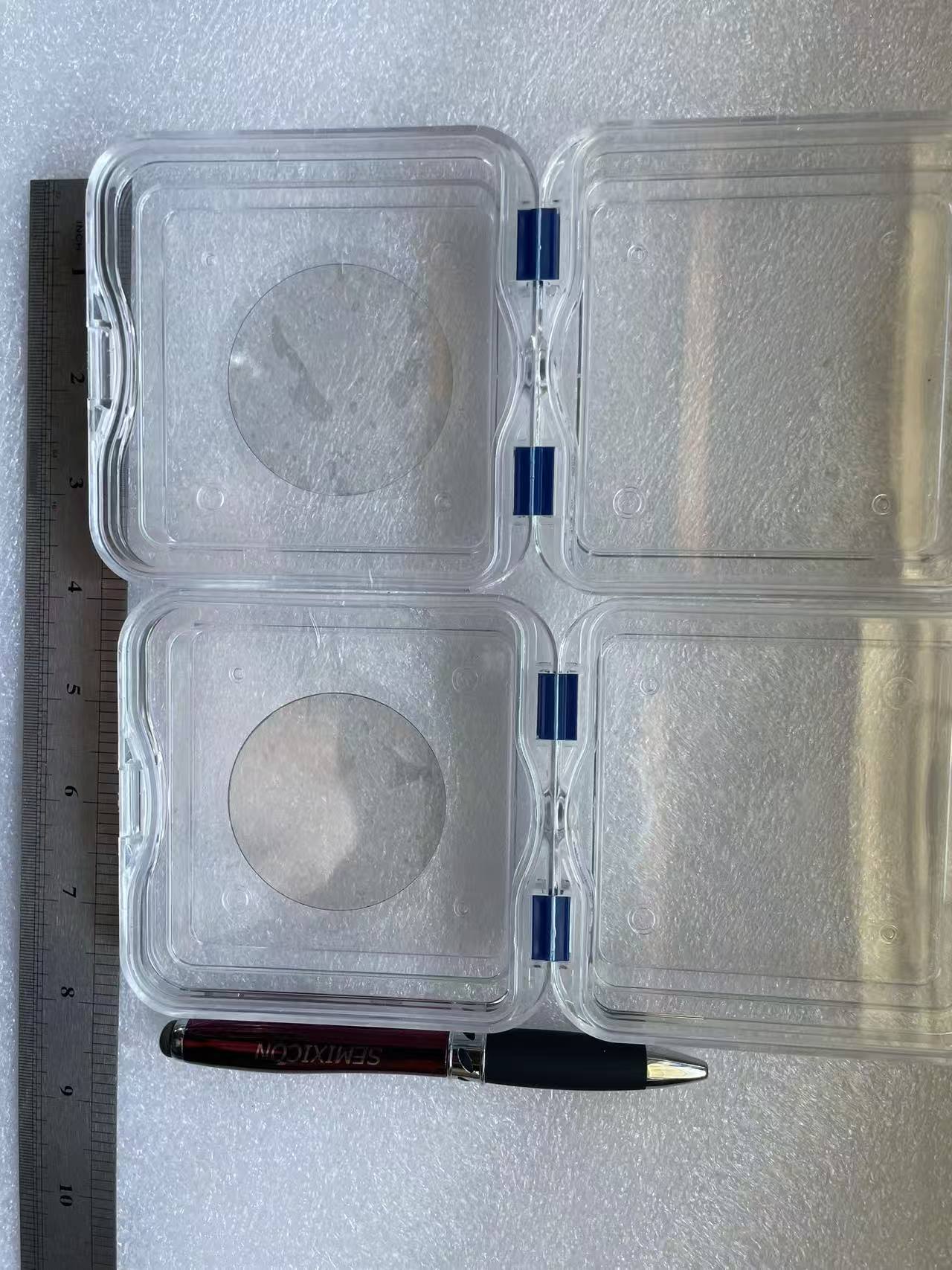
Anti reflection Coating on Optical CVD Diamond Window HfO ,La ,Nd and etc
May3, 2026
Advanced Anti-Reflection Coatings for Diamond Infrared Optics (Including Nd-Based Rare-Earth Systems)
Diamond is widely utilized in infrared (IR) windows and optical components due to its exceptional hardness, ultra-high thermal conductivity, and broad spectral transparency. However, its high refractive index (n≈2.4n \approx 2.4n≈2.4) leads to significant Fresnel reflection losses, limiting the theoretical transmittance to approximately 71% in the infrared region. Therefore, the development of advanced anti-reflection (AR) coatings is essential.
1. Hafnium Oxide (HfO2HfO_{2}HfO2) for AR Coatings
Hafnium oxide remains a key high-index material in diamond AR systems:
High refractive index (n≈2.0n \approx 2.0n≈2.0) enables effective index matching
Wide bandgap and excellent transparency (0.22–12 μm)
Superior thermal, chemical, and radiation stability
It is commonly used as a high-index layer in multilayer AR stacks.
2. Rare-Earth Oxides Including Nd-Based Systems
Rare-earth oxides such as Y2O3Y_{2}O_{3}Y2O3, La2O3La_{2}O_{3}La2O3, and Nd2O3Nd_{2}O_{3}Nd2O3 provide additional degrees of freedom in tailoring optical and structural properties.
(1) Y2O3Y_{2}O_{3}Y2O3 and La-doped systems
Effective in LWIR (8–12 μm) AR enhancement
La doping reduces surface roughness and improves film density
Multilayer systems can achieve >80% transmittance
(2) Nd-based rare-earth oxide (Nd2O3Nd_{2}O_{3}Nd2O3)
Neodymium oxide introduces both optical and microstructural advantages:
Refractive index tuning:
Nd2O3Nd_{2}O_{3}Nd2O3 has a relatively high refractive index (n≈2.1n \approx 2.1n≈2.1–2.2), enabling better gradient matching between diamond and low-index layers.Optical functionality:
Nd³⁺ ions exhibit characteristic electronic transitions, which can be leveraged to:Tailor spectral response in near-IR regions
Potentially suppress unwanted reflection bands through absorption-assisted design (carefully controlled)
Microstructure improvement:
Nd doping in Y2O3Y_{2}O_{3}Y2O3 or mixed rare-earth oxides can:Refine grain structure
Reduce columnar defects
Improve film uniformity and adhesion
Thermal stability:
Nd-containing oxides maintain good stability under high-power IR irradiation, making them suitable for laser window applications.
(3) Composite rare-earth oxide systems
Combining YYY, LaLaLa, and NdNdNd oxides enables:
Fine refractive index engineering
Reduced scattering losses
Improved broadband AR performance
3. Fabrication Techniques and Interfacial Engineering
Diamond growth: MPCVD
Thin film deposition: magnetron sputtering, PLD
To address thermal mismatch:
Interlayers: AlN, Si, Ge
Graded-index structures: smooth refractive index transition
Key issue:
Avoid parasitic phase formation (e.g., SiO2SiO_{2}SiO2) due to oxygen contamination, which degrades IR transmission
Precise control of:
Oxygen partial pressure
Substrate temperature
Film stoichiometry
is critical.
4. Conclusion
The integration of:
HfO2HfO_{2}HfO2 (robust high-index layer)
Rare-earth oxides (Y2O3Y_{2}O_{3}Y2O3, La2O3La_{2}O_{3}La2O3, Nd2O3Nd_{2}O_{3}Nd2O3)
Advanced multilayer and graded-index designs
enables significant enhancement of diamond infrared transmittance from ~71% to >80%, with improved environmental durability and structural stability.
Nd-based systems, in particular, offer additional refractive index tunability and microstructural optimization, making them a promising component in next-generation diamond AR coatings for high-power laser and extreme-environment applications.